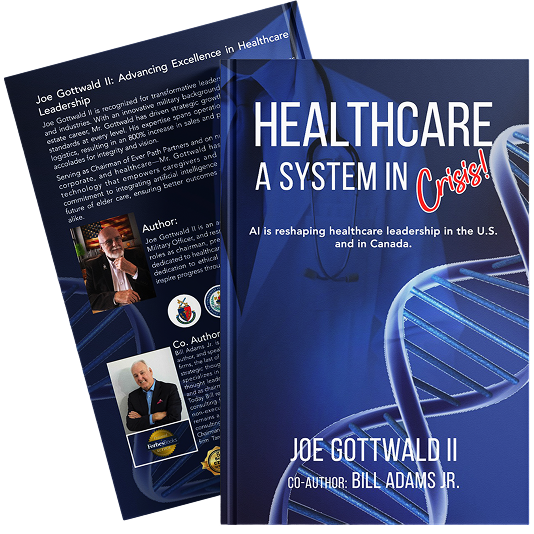



HEALTHCARE
A SYSTEM IN CRISIS
Joe Gottwald II combines three decades of military leadership with expertise in healthcare innovation and artificial intelligence. His book ‘Healthcare: A System in CRISIS’ examines critical challenges facing the healthcare system and presents solutions for improving elder care, integrating AI technology, and addressing the needs of an aging population.
Joe Gottwald II is a seasoned executive whose career spans military service, real estate, healthcare innovation, and artificial intelligence. His military career included three decades of service, rising from Private to Colonel, managing operations supporting over 40,000 personnel as Operations Officer for the largest Transportation Group in Europe. After 9/11, he served in Search and Rescue missions with his K-9 partner Mercedes.
Joe earned his bachelor’s degree while attending U.S. Army Command and General Staff College and a master’s degree in Contemporary Leadership and Operations from the Dwight D. Eisenhower School of National Defense University. He holds SHRM certification in human resources management and has completed post-graduate studies in business, healthcare, and artificial intelligence.
In real estate, Joe orchestrated an 800% increase in sales and personnel within four years and managed millions in mergers and acquisitions. He has served on boards for over 30 years in various leadership capacities. Currently, he serves as Chairman of the Board at EverPath Partners, a healthcare corporation, and was named one of the Top 10 Healthcare Innovators for 2025 by Global Healthcare Magazine.
Bill Adams Jr. is an American businessman, management consultant, author, and speaker specializing in innovation and transformation. He has built and sold multiple companies, including a management consulting firm acquired by Dell/Perot Systems in a pre-IPO transaction, as well as a performance software company acquired by a midsize consultancy.
A trusted strategic advisor to Fortune 50 and high-growth companies, Adams has served on four NASDAQ boards and acted as interim CEO for six public companies navigating reorganization, SEC challenges, and insider buyouts. He currently leads Whitespace as a strategic thought leader and serves as Chairman and CEO of Targatek, Inc., where he continues to drive performance-focused innovation and executive transformation.
About the Book
Healthcare A System In Crisis
‘Healthcare: A System in CRISIS’ examines the critical challenges facing modern healthcare as the aging population creates unprecedented demands on the system. Co-authored by Joe Gottwald II and Bill Adams Jr., this comprehensive guide addresses how artificial intelligence and machine learning can transform healthcare delivery in retirement communities, assisted living facilities, and hospitals.
The book covers practical applications of AI in healthcare, from personalized medicine to operational efficiency, while addressing ethical considerations around data privacy and maintaining human oversight in medical decisions. The authors explore how COVID-19 exposed vulnerabilities in healthcare systems and accelerated technology adoption, particularly telemedicine.
Key topics include staffing shortages, rising operational costs, changing resident expectations, and the technological gap in many retirement communities. The book presents solutions for improving resident care, training staff, enforcing safety protocols, and implementing sustainable practices. From chatbots and companion robots to cognitive training programs, the authors demonstrate how emerging technologies can enhance care quality while supporting healthcare workers. This essential resource provides healthcare leaders, administrators, and policymakers with actionable strategies for building a sustainable future in elder care.
Testimonials
Hear real stories from our wonderful clients worldwide
Healthcare professionals, administrators, and industry leaders share how ‘Healthcare: A System in CRISIS’ provided actionable strategies for improving elder care, implementing AI technology responsibly, and addressing the challenges of serving an aging population.
This book does not theorize from a distance.
It speaks from the lived reality of leadership inside complex systems. The authors confront uncomfortable truths about healthcare and offer practical direction without oversimplifying the stakes. I finished it with a clearer sense of what responsible innovation should look like.
Healthcare discussions often swing between fear and
hype when technology is involved. This book does neither. It treats artificial intelligence as a tool, not a replacement for human judgment, and that balance is rare. It is one of the few resources I would confidently recommend to both administrators and frontline leaders.
What impressed me most was the operational honesty.
Staffing shortages, regulatory pressure, and rising costs are addressed head on. The solutions are grounded, implementable, and respectful of the people doing the work every day. This is not abstract policy writing. It is usable.
As someone responsible for long term planning,
I found this book timely and sobering. The demographic realities are unavoidable, and the authors make it clear that delay is no longer an option. The emphasis on ethics and oversight strengthens the case for adoption rather than weakening it.

This book connects leadership, technology,
and care in a way that feels earned. It reflects deep experience across disciplines, not borrowed insight. The sections on resident dignity and staff support stayed with me long after reading.

If you work in elder care and feel the system straining
around you, this book puts language to that experience. More importantly, it offers a path forward that respects both patients and professionals.